I decided to take a break last week, as you could probably tell. But I'm back!
FOOD
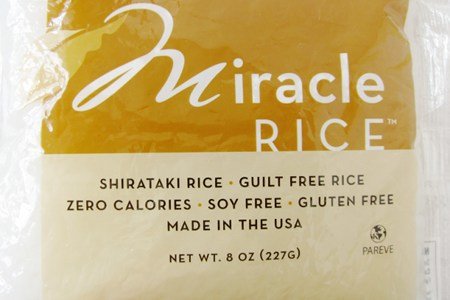
I finally went ahead an tried the miracle rice. I really didn't care for it. It has the texture of boba and it's tasteless. Even when I added seasoning and some olive oil, it still didn't have much flavor. Who knows, maybe I didn't cook it the way it should have been. If you decide to try this, I would definitely keep it within Asian dishes. I don't think it would work well with any other type of food. Especially the noodles. They seem more like a ramen type noodle.
FITNESS

Ignore the short-term results. If you commit to the long-term process, the results will come anyway.
Happy lifting.
I decided to search for a fitness article to add this week and I came across this one. It's a fantastic chunk of very valuable information! It's called 6 Truths About Exercise That Nobody Wants to Believe.
Success in the gym, as with most things in life, comes down to mastering the basics.
With that in mind, here are six exercise tips, weight lifting basics and training essentials that nobody wants to believe, but everyone should follow.
Take these ideas to heart and you'll reap major benefits. While most
people waste time debating the endless stream of supplements, "new"
workout programs and diet plans, all you really have to do is focus on these simple concepts and you'll see results.
1. You need to commit for the long term.
Most people work out with a short-term goal in mind. I like looking at health in a different way.
- The goal is not to lose 40 pounds in the next 12 weeks. The goal is to regain your health for the rest of your life.
- The goal is not to bench press 300 pounds. The goal is to be the guy who never misses a workout.
- The goal is not to sacrifice everything to get your fastest time in next month's race. The goal is to be faster next year than you are today. And faster two years from now than you will be next year.
Ignore the short-term results. If you commit to the long-term process, the results will come anyway.
Furthermore, stop acting like living a healthy life is a big deal.
You can go to the gym every week. That can be "normal" for you. Not a
sacrifice. Not an obligation. Normal.
What's funny is that when you commit to being consistent over the
long term, you end up seeing remarkable results in the short term.
That's the power of average speed.
2. You need to set a schedule for your training.
Most people never train consistently because they are always wondering when they are going to train next.
They are always wondering:
"Will I be motivated to work out when I get home from work?"
"Will I have enough free time to exercise today?"
"Will I have enough willpower to wake up early and run?"
In other words, most people train when they feel motivated or inspired.
Here's a better idea. Stop treating exercise
as something to do when it's convenient and start setting a schedule
for yourself to follow. This is what makes the difference between
professionals and amateurs.
For example, I train every Monday, Wednesday and Friday at 6 p.m. I
don't have to think about when I'm going to train. I don't sit around
and wonder which days I'll feel motivated to lift. I don't hope that
I'll have some extra time to work out today. Instead, I put it on the
schedule and then organize my life and responsibilities around it (just
like you would organize your day around your class or your meeting or
your kid's baseball game).
Setting a schedule for your training becomes even more important when
life gets crazy. There will always be occasional emergencies that
prevent you from working out. It's part of life. The problem is that
most people miss one workout and before they know it, they haven't been
to the gym in four weeks.
But when you have a schedule for your training, you have a way of pulling yourself back on track as quickly as possible.
Top performers make mistakes just like everyone else. The difference is that they get back on track
quicker than most. Miss your workout on Friday because you were
traveling for work? Guess what? Your next training session is already
scheduled for Monday at 6 p.m. I'll see you there.
Let your schedule govern your actions, not your level of motivation.
3. You need to focus on the best exercises.
Great results come from great focus, not great variety.
Too many people waste time in the gym because they bounce around
without any real goal, doing a little bit of this machine and a little
bit of that machine. Thankfully, there is a simple rule that will always
guide you toward the best exercises: the more an exercise makes you
move, the bigger the benefits it will deliver.
This is why the clean and jerk and the snatch are the kingpins of
weight lifting. They are the exercises that force your body to move the
most (and the quickest). As a result, the people who do these exercises
see incredible results.
Here's a short list of the best exercises. In my opinion, at least
one of the first five exercises should be included in every workout.
- Squat
- Deadlift
- Bench press
- Clean and jerk
- Snatch
- Sprints
- Overhead press
- Good mornings
- Pull-ups
- Push-ups
4. You need to start light and train for volume before intensity.
Ask most people if they had a good workout and they'll say things
like, "Oh yeah, it was so intense." Or, "I'm going to be so sore
tomorrow." Or, "I finished my workout by doing a set to failure."
It's great to push yourself, but the biggest mistake that most people
make is not building a foundation of strength. Everyone wants to jump
in and max out with a weight that is "hard." That's exactly the wrong
way to do it. Your workouts should be easy in the beginning. (See: "How to Start Working Out.")
Training to failure is a good way to wear yourself down, not build
yourself up. You should have reps left in you at the end of your workout
(and at the end of each set). Take point #5 (below) to heart, and your
workouts will get hard enough, fast enough. Trust me.
The phrase that I like to keep in mind is "train for volume before
intensity." In other words, I want to build the capacity to do the work
before I start testing my limits.
Just to be clear. Volume doesn't have to mean "do sets of 20 reps."
(I rarely do more than 10 reps in a single set.) Instead, I like to
think of volume over a period of weeks and months.
For example, right now I'm doing a 5 x 5 squat program (five sets of
five squats). I started light. The first week, I lifted with a weight
that was very easy for me. Then, I slowly added five pounds each week.
For weeks, it was still easy. Eventually, when I built up to a weight
that was heavy, I had the capacity to handle it because I had already
done dozens (if not hundreds) of sets over the previous weeks and
months. Focusing on volume now allows you to handle the intensity later
on.
5. You need to make slow progress each week.
Most people walk into the gym every week, do the same exercises with
the same amount of weight, and wonder why they aren't getting stronger.
You'll see people step onto the same treadmill, run two miles like they
always do and wonder why they aren't losing weight.
Here's a little story that explains the problem and the solution.
Imagine that you are in a quiet room and someone turns on a loud and
noisy fan. At first, it's obvious and irritating. But if you are forced
to stay in the room long enough, the fan starts to become part of the
background noise. In other words, your body registers the sound at
first, but eventually it realizes "Oh, this is the new normal for this
environment."
Your body adapts and the noise fades away. Something similar happens when you exercise.
When you start to train, it's like turning on the fan. Something new
is happening in the environment, and your body registers the change by
getting stronger and leaner. But after a few workouts, your body
realizes "this is the new normal." Your body finds a way to adapt to
this new environment, just like it did with the noisy fan. As a result,
you stop getting stronger and stop losing weight.
What got you here won't get you there. If you want to see different
results, you have to do something different. If you want to see progress
each week, then you have to progress each week.
This is actually very simple to do. Add five pounds each week. Add an
extra set this week. Do the same exercise, but rest for 15 seconds less
between sets. These are all ways of changing the stimulus and forcing
your body to slowly and methodically get better.
6. You need to record your workouts.
What gets measured, gets managed. If you can't even tell me how many
sets and reps you did with a particular weight two weeks ago, how can
you guarantee that you're actually getting stronger?
Tracking your progress is simple: get a small notebook and write down
your workouts. (I use a little black Moleskin notebook that I bought a
bookstore.)
At the top of the page, write the date of your workout. Then, simply
write down the exercise you are doing. When you finish a set, record it
in your notebook while you're waiting to do the next one.
Recording your training is especially important because it brings all of these points together.
You can look back and see how you're making long-term progress (point
#1). You can see on which dates you trained and how often you were on
schedule (point #2). You can verify that you did the best exercises each
workout (point #3). You can see how you are slowly building up volume
and developing a foundation of strength (point #4). And you can prove
that you're making slow methodical progress each week (point #5).
What You Should Do Now
Your could spend your entire life mastering these six points, but
these are the basics that will make a real difference in your training.
Here are your action steps:
- Set a schedule. When and where, exactly, are you going to train?
- Get a notebook and pen to record your training.
- Focus on the best exercises that make you move a lot.
- Start with a weight that is very light and train for volume before intensity.
- Slowly increase the weight each week.
Happy lifting.
Source: http://www.huffingtonpost.com/james-clear/exercise-tips_b_3805307.html?utm_hp_ref=mostpopular
WRITING/LITERATURE

I finally forced my self to finish The Gargoyle by Andrew Davidson. The story it's self was incredible! I loved every bit of it, the ending however I was a bit disappointed in. It wasn't so much predictable as it was anti-climactic. But it went in the direction it had to. All in all a fantastic read!
Thanks again to my good friend, Eduardo Loera, for letting me borrow his copy of the book. Finally after about 4 months or so I can get it back to him! :-)
PIECE OF MIND

Because of my friend Mo's brilliant talent and success with Etsy, I'm thinking I might open one my self selling homemade candles, bath salts, and things of that nature. Not 100% sure if I'm going to do it yet, but I really want to depending on how many people might be interested. Give me some feed back, guys! :-)
Thanks for reading! I hope everyone has a fun and safe Labor Day weekend!
Tumblr
Most photos found through Google search. I do not own, nor take credit for any of them.
(Accept for my personal photos) If you choose to try/replicate
anything I do/suggest on my blog it is your doing. I can not/will not
take any responsibility for injury caused by diet, exercise, cooking, or
anything else you choose to try from my blog. They are suggestions and
suggestions only.


.jpg)


